

Dunhumvi’s Beer
Wild rallies, mysterious inclusions in a bottle, little doors, little offices, Dunhumvi goes down in the dark

At the end of the march, at the rally in the circle under the shadow of the black high-rise, everyone’s body reflected in the featureless curves of its glass, behind which kiosks showcased watches and whiskeys, behind which a giant suspended star cycled slowly from green to pink to yellow, Dunhumvi floated at the outskirts.
A man sat atop a knocked-over newspaper box, cackling. His blue mask, brown on the inside, hung from one ear. A woman in black jungle tacticals advanced and shouted at a crowd. A large brown man pulled her away. Men with round shields surrounded four kids in soccer shirts. The men’s shields were striped with white tape, one strip across another, forming a cross.
Dunhumvi backed out of the fray. Someone smacked a flyer against his chest. On the paper, there was a drawing of a skull in a cage, but the words underneath it were just a jumble of characters and numbers. The symbols were arranged in a sequence that only simulated language; they were actually meaningless, disordered, and concealed.
The woman in black again. This time, she lunged at the men with shields. Her neck was taught. The kids in soccer shirts ran away. The artery under the woman’s neck skin bulged, bright indigo against capillary pink. Massive police trucks rolled into the circle. They cut across the far end of the crowd, dividing the gathering by one third.
He turned a doorknob and slipped into an apartment, a drab green room with a card table and folding chairs. There was something on the table. A sandwich. Wheat bread and tuna from a can and a brown bottle of beer, which was cold forbidden and lightened his head so that when she asked him where he grew up what is this he said he thought he lived in you are wrong the woods think again.
At night, in another room of the same apartment, she slept on violation of her stomach, face turned to one side. Dunhumvi leafed through maps and papers under a soft yellow cone of electric light. Streets laid out in grids discontinued. One of the pages showed the footprint of a building filled with hallways and little offices. omitted It had been traced from some other page in blue ink blackout blackout and there were additional floor plans traced just like it. There was a page that showed where he lived.
The sheets were tangled, and the area underneath him was sticky with sweat. It smelled sour. But his head wasn’t shrinking anymore; the crushing sensation had ceased. He walked tenderly in the dark and held himself up against the shower tiles. The hot water ran and ran and ran.
After the steam cleared, he bundled his clothes and dropped them into the trash under the kitchen sink. The drab green apartment was empty except for him. The beer bottle was in the kitchen sink. He turned it over, and the last of it sputtered out. There was something else inside the bottle.
He tapped the light above the sink. The chrome-white panel lit. He pried inside the glass neck tube with one finger. The thing came halfway out and then popped free and circled the sink. Dunhumvi caught it with one hand. Up close to the light, there it was, a little dark capsule. A black plastic pill. Not a pill but like a pill. Holding it still on the counter between his thumb and index finger, Dunhumvi used a knife from a drawer and sawed into the thing. Its damp surface came apart just enough that he could shake its insides free. Little black beads. Hard dots. He looked at them in the flat of his palm. Were they cold? They felt cold.
Opening the accordion doors of the hallway closet, he looked inside the drawers of metal cabinets, each four compartments high. He lifted the edges of tied-together sheafs, stapled and paper-clipped printouts, folders, packets, and envelopes, glossy headshots and many-colored pages. Another drawer opened to reveal nests of cables and adaptors, and another was a coffin for pens and black markers and office debris. There, in the last one, yes. A little rectangular magnifying glass.
The little beads in his palm under the light, under the magnifying glass, they looked like, no, yes, they were tiny black metal spheres. He clenched his hand and unclenched it again. The dots remained. Had these been in his bottle? Had he consumed something? Had he swallowed something soaked into the beer from all of these spheres?
He walked out of the apartment, shirtless, into the brilliant white hallway, elbowing open the trash room door, yanking open the door of the chute on the wall, and shoving the whole package he’d gathered into the blackness (which smelled of rot). The sound of the glass bottle booming against metal walls.
When he turned around, there was a face. The door of the apartment across from the trash room—it was the apartment that shared one wall with the kitchen in which he’d discovered the dots—was now ajar. The woman’s face, looking out at him from the gap, was gray. Or it seemed gray. Her skin looked like old newspaper. A muscle under her left eye quivered. It ticked out dots and dashes. It ticked out a code. He tried to remember the sequence. If he could remember the dots and dashes, he could jot them down, translate them and read what she was trying to say. The woman shut the door with a click.
The man with the thinning black hair showed him a picture on a laptop. A teenager’s unmasked face floated on the screen.
Sitting across from the laptop, perched on the edge of a hardwood chair, Dunhumvi’s feet felt as if they were on fire long walk from where you are and then he peered into the laptop screen again maybe someone you’ve and his eyes went to a spot on the side of the man’s head there is no blood and he watched the man’s fingers lifting. There was a scab there.
On the desk, just behind the man, there was a familiar thing, the corner of a page want you to understand that for the time being we cannot and he leaned a little bit to the right, the crenelations of the scab under the man’s fingers lifting while the man tapped something into the laptop with the other hand. The page had been in the bedroom. It had been covered in blue ink. It had been in the apartment you say there was a light with the bottle and the capsule and the spheres.
Something shifted on the other side of the office wall. Something leaning against the wall on the other side moved, and the sound of it came through the boards and insulation. Dunhumvi’s fingers felt hot and wet. He jerked them away from his head, from the scab (which had started to give), and his fingertips were dark red if you do not make the decision and, when he looked from his fingers to the man with thinning black hair, the man had no scab and was not picking at it, and the man snapped his mouth wide open and the air exploded with a blast of static, an ear-ripping bark.
It was no longer possible to tell if anyone was handsome or pretty. The masks left only eyes and eyebrows, hairlines and foreheads, barely even cheeks.
Dunhumvi passed two girls on the stairs; they were coming up, and he was going down, and they couldn’t have been more than girls, really. They were maybe half his age. The pair paid him no attention. The banister turned under his hand.
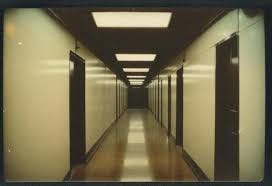
The lighting changed. Now, he was below, down in the hallways. He passed open doorways. Little offices filled with chairs and desks and books. A bank of larger rooms arranged into grids. Workstations with silver faucets and rows of plastic bins. Some of the bins held syringes. Some had pouches and packets and circular plastic dishes. The hallway split, and Dunhumvi took the left-hand route, which became a narrower passage with no doors, and then he descended a second, short flight of stairs.
The door was closed. He listened. He tried the knob, and it turned, and Dunhumvi slipped inside. Inside the little office, a gossamer-black wire ran along the floor, starting at the base of the leg of its one desk. Tucked into the seam between two wooden floorboards, the wire ran from under the foot of the desk’s leg straight to the wall. There, it turned and ran along the baseboard of the wall, and then it disappeared into a gap at the edge of a little door frame.
Dunhumvi crawled behind the desk. On his hands and knees, he pushed a cardboard box aside, clearing a little more room to get at the small door, which was not quite closed. He turned so that he was sitting on one haunch, and he pried open the little door as far as it would go. It stopped after a foot, maybe, bumping up against the side of the desk.
He wedged his head through the opening. At first, there was only darkness, just a black void beyond where the thread-thin wire vanished. His eyes adjusted. Wooden studs. The backside of other rooms’ walls. Farther back, there was a square of lighter dark. It was the size of the one through which he looked.
The sound of shoes in the hallway. Dunhumvi pushed the little door shut, sliding the document box back across it. He crawled backward on his hands and knees, his head rapping against the underside of the desk this is and he stood up you are half-blind, as a man with light red hair and shiny high cheekbones entered the room. Behind the red-haired man was the man with the thinning black hair.
The red-haired man told him to sit. Dunhumvi sat in a black plastic office chair across from the desk. There was no little door behind it, just a wall and stacks of cardboard boxes. There was no wire running from the desk’s leg, and no little door, half open hurt yourself and nothing else down there at all cut your but papers, get him something. There was nothing that he could see at all.
Dear reader: Everything Is Useless And Nothing Is Solved celebrates its first birthday next month. If you’d like to support this work, paid subscriptions open on May 3. Five bucks a month or fifty annually—or a buck-fifty if you’d like to sign on as a founding member.
There’s more to come, including a hardcopy, illustrated EUNS book at the founding member level. Stay tuned. Oh, and it should be said: Whether paid subscriber, free subscriber, or just stopping by from somewhere on the internets, all EUNS articles will remain open to read by all. No paywalls.
Thank you again for your support. See you next Sunday!