

Dunhumvi’s Sandwich
Wires in museums, hassles on the street, and the magical appearance of a crisis-framed BLT

There was a man on the edge of the sidewalk, sitting at the seam where it met the street, his head bleeding. A bicycle was collapsed in a tangle beside him, and a large, soft, square bag lay next to it. Two women were holding his phone and trying to speak to it he pulled the wire but the language they spoke wasn’t English. The man touched his head near the spot from which it the wire was bleeding, and a line of red slipped along his finger and raced the length of his arm.
Dunhumvi’s bus arrived, and he boarded it and sat in one of the single blue seats. The whole of the ride, and no matter which way the bus turned, a triangle of sunlight stuck to his face, and when he got up to leave, his mask felt moist, and the light through the window’s glass had rendered him halfway blind.
The girl in the museum doorway asked him for his ticket. He reached into his pants, tugging aside the ends of his layers of shirts means something to access the cargo pocket and produced his receipt. there is no He held it out. After she looked at it, the girl pointed a tiny gun-shaped device at his head. It fired a ray of invisible energy. He returned the ticket to his pants. thing She looked at her device, and he moved along, walking into the museum.
In the mirror-polished marble underfoot, in its almost-mirror surface, he could see his own legs lift and move, birdlike but in reverse. Beyond his legs, in the reflection of the glass surface of the floor, his body grew faint and vanished. The marble under his sneakers whispered.
In a wide and otherwise empty hall, arches framed alabaster statues. Their surfaces seemed slick to him, wet with inner life. He realized polishing them he was talking again. the oil of human hands A squat, dark-skinned woman in a black uniform watched him. A single coiled wire ran from her left ear into the collar of her shirt.
Dunhumvi sat on a wooden bench at the side of the smallest of the Greek and Roman rooms. Imperial busts and armless gods. erasing all those fingers Quiet now. He’d stopped talking. once touching A handful of roamers came in. They held up their phones, documenting the millennia with squishy insect clicks. The room felt too warm. He looked again at the receipt that had let him enter. Moisture from his leg wet hands had smeared the ink. It was very thin. wet life The paper of the ticket felt like onion skin. He touched his forehead where the beam had entered him.
It was on his last circuit that he found the wire. He further scanned the pedestals and their sculptures, the busts and stone. It was the only wire he could see. It emerged from just behind the second-largest statue, back in the last room before the section returned to the main hall (closing the loop of history).
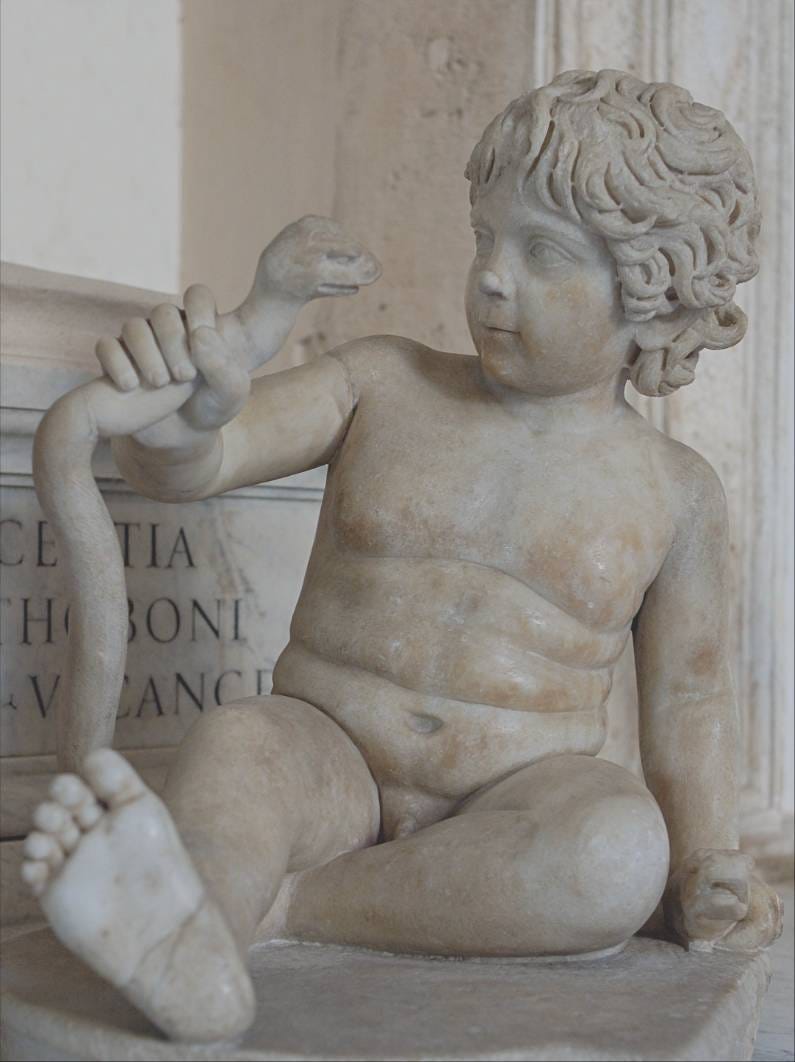
The wire extended from the foot of Hercules, his legs entangled in serpents. It was virtually invisible, but standing to one side of the plinth too close he could see it—a tiny strand of white just like the surrounding marble. It ran down the statue’s base sir and along the seam of two tiles and then to the corner point where the museum wall met the floor. It climbed the corner of the room, where the two walls met. Way up at the top, near the arched ceiling, there was a small square steel hatch, featureless except for a little hole. The wire went into it. He crouched to touch the white thread, kneeling where it followed the seams. A woman in a black suit not allowed hurried toward him sir with a radio in one hand.
The ticket wasn’t in his pocket anymore. He searched for it while he sat at an outdoor table, an ambulance pulsing. His pockets were damp, but there was nothing in them.
The waiter brought him an iced tea and said his sandwich would be delivered shortly. Dunhumvi couldn’t hear anything the waiter said. He could hear nothing over the whirring of the siren. The ambulance stopped directly next to his table. People on the sidewalk stopped. Everyone stood around him where he sat, his hand on the beaded plastic cup of tea.
The ambulance doors opened, and a short, young technician—his skin shining black against his white shirt collar—hurried into the very restaurant where the waiter had gone. The man carried a folded stretcher. A heavy woman with blonde hair emerged from the ambulance. She carried a tank. Some kind of gas.
They wheeled out a thin elder with luminescent hair, silken snow-white hair that fanned out around his shoulders. His shirt was open, and the woman’s tank of gas was now connected to his face by a plastic mask and tubes. Dunhumvi that could be one could see the knobs of the man’s bones under his chest. They bulged from beneath his exposed skin. Clavicle and breastbone. His head lolled to one side. do you still want this The waiter stood next to Dunhumvi’s table with a plate. The memory is he sick of what he’d ordered. somebody ask the ambulance What had it been? On the plate, there was bread, bacon, and lettuce, tomato and a little cup of what seemed to be mayonnaise. It was all in a stack, except for the cup. It was a sandwich, after all.
Dear reader: Everything Is Useless And Nothing Is Solved celebrates its first birthday next month.
First and foremost, thank you for reading EUNS.
Second, if you’d like to support this work, paid subscriptions open on May 3. Five bucks a month or fifty annually—or a buck-fifty if you’d like to sign on as a founding member.
There’s more to come, including a hardcopy, illustrated EUNS book at the founding member level. Stay tuned. Oh, and it should be said: Whether paid subscriber, free subscriber, or just stopping by from somewhere on the internets, all EUNS articles will remain open to read by all. No paywalls.
Thank you again for your support. See you next Sunday!