Jealous Dead
The truth about the dead and the living; Detective Bob Roberts needs a late-night bullet

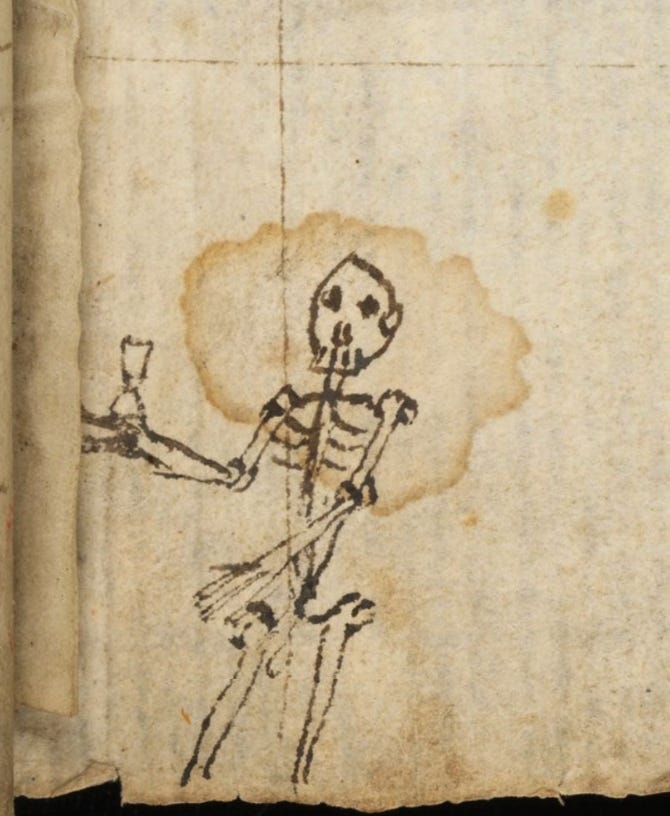
The dead resent us. They cannot have it any other way. The tax upon them, upon their dying, is levied forever—to be jealous of those who remain, to be jealous of those who live.
The dead are the ones who are haunted. For the living, for those who survive the dead, the moment of extinguishment, the moment of the fire’s quenching, becomes incorporated into all the time that follows. The very gasp of death, which wrenches the living into a crystalline moment, sends their beating hearts reeling into nights of fire, but always eventually cooling. Weeks and months of drifting soot and ash. And then a settling.
For the living, death is a memory of what the living did. But the dead are frozen in their last instant—be it gentle or be it ferocious—and they live on, in a way, locked in an unliving cell that divides them from whatever was alive. They are endless, and they are angry, and they go on forever.
The living, in life, claim that they want their loved ones to live on, to live longer lives, but the jealous dead want things differently. The jealous dead want every living being to die at once, to be in death alongside them, and for nobody to live on without them, merely absorbing the fact of their death into the routine of living life, during which the living then find joy in rooms where the dead no longer linger.
The blue light of the late-night hallway down in the city morgue made the walls look like they were tiled with turquoise. It was just past four-thirty. The face of the clock on the wall by the security desk was alabaster, semi-luminous. Roberts’s nose burned as the infection he’d caught a week ago worked its way in deeper.
He tossed his cardboard cup of cold coffee into the trash as he passed the unstaffed station. He stopped, took a travel-size container of cream from the bin at the upper-left corner of the desk, ran a fingertip of the stuff under each nostril, and pushed through the swinging doors into the lab.
Loyola Zhee worked at a central table. She pointed a black camera at the blackened shape in front of her, its death-frozen and charcoaled fingers curled, its two hands reaching toward the fluorescent ring under which she worked. The circular light threw a cone of white-blue, which gifted the edges of her head and face with a kind of halo. The braids Roberts loved were hidden under her cayenne paper cap. The flash strobed, then pulsed. Two other bodies waited under white-blue shafts behind her.
At the next table, the mound was wholly covered by a pea-green sheet. Beyond that, at the third one back, the cracked and roasted mass of the driver rested uncovered atop its steel platform. It was bent over in a permanent incinerated crouch, just the way the man had been sitting when the heat and flames inside the car had blasted most of the flesh from his bones.
The air was so thick, he could taste it through his cheeks and teeth. Roberts wiped the cream from under his nose. He pushed his tongue back down to the center of his mouth so that he could utter a hoarse hello.
“I understand you have a problem with ballistics,” Loyola said, capping the camera’s lens and setting it aside. “Do you have the gun?”
“You know about the gun?”
She paused, squeezing the tip of her tongue between her lips and then raising her eyebrows, then picked up a metal tray and a steel pick and came around the table.
“Beyond your problem on table number three, your two rear passengers, here and in the middle, are young males.” Her tall, swooping forehead nodded back toward the second body.
“Teenagers,” she said. “Fifteen, I’d say. Maybe a year either way.”
“Keep going.”
She stood beside the first table, pointing at the charred and shiny skull with the metal pick.
“This one was deceased prior to the fire,” Loyola said. She indicated a thumbnail-sized aperture, just above the now-incomprehensible mass of grime and gelatin that used to be an eye socket on the left side. “One shot.”
“Is there a bullet in there?”
“There’s no obvious exit wound. Maybe the eye. When I open the skull, we’ll know.”
At the second table, she lifted aside the covering, which was mottled black and glistened beneath, revealing the second body, blackened from top to toe. She touched the pick to the exposed edge of its pelvis, grease-streaked and cracked apart.
“I’m getting lucky tonight,” she continued. “Non-fatal entry. Clean through the ilium. I’d say your projectile passed through the soft tissue and into the vehicle. Maybe out of it, too. If you’re looking for bullets.”
“Same bullet?” he asked.
“Maybe. That’s up to forensics.”
She moved to the end of the table.
“Surgical pin implanted in the left foot. Could be a year or more. Get a list of missing persons, you could start looking for surgeries.”
“Dentals, too,” he agreed. “Dental records. Everything.”
She took him to the center of the last table.
“Significant entry damage to the sternum.”
“Same gun?”
“It’s a gunshot. Close range. There’s a chance that the round is still inside the thoracic; we’ll know as soon as I get in there, too.”
Loyola put the pick down and held out the metal tray.
“And here’s what you had just inside the superior lobe, up in the ribs.”
Inside the tray were two objects. One looked like a melted circuit board about the length of his thumb, and the other was part of what looked like a flat lithium strip, crackled and broken open from the inside. The whole thing couldn’t have been larger than his index finger.
“What am I looking at?” he asked.
“It’s a digital recorder,” she replied. “Or what’s left of one. It was probably in his shirt or jacket pocket. It sinks into the tissue as the heat breaks everything down. Sticks to the superheated bone when he slumps over.”
“Steering wheel helps keep it in place,” he said.
“I see. Looking for a job?”
Roberts pinched the space between his eyes and wished he had a hot cup to follow up the cold one he’d dropped in the trash. He walked around the table as she set the pan back down. He squatted so that the face of the immolated driver was at eye level. Lips pulled back from teeth, a hint of where the brow once arched. The sockets were empty, and the cheekbones below them were only crusted mounds. A shock of tissue had clumped atop the head, near where a hairline would have started, the mound of melted organics now hardened where it had slid forward across the skull.
“Son of a bitch,” he said. To the dead. To the room.
A slow trickle traveled the sloped steel, leaving the lumpen remains of the undercover officer, following a groove down the surface’s metal middle, and plipping away into a drain underneath. When Roberts looked up again, Loyola still stood where she’d put down the tray.
“How do you like your new assignment?” she asked.
He stood up and looked back at the first two tables, each with its unmoving and adolescent load. “I need those bullets,” he said. “Let’s open up the kid.”