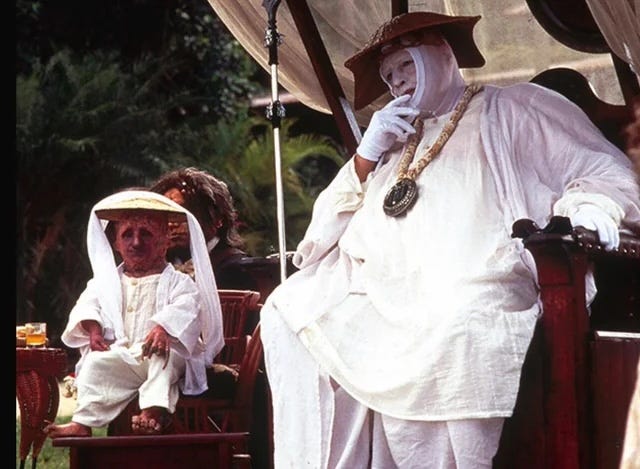
Nothing Like A Story
Lunch with Marlon Brando, savagery, the death of waking dreams, a glass of untouched wine

Reversing the projector. The rattle of the strip as it traverses the span between reels. It shivers and jumps like a rope bridge. Eventually, it flaps and flies from its take-up wheel.
He switches off the machine and flips open the latch that keeps the spinning circle from vibrating free and rolling across the floor. There was one time, when learning about projectors—this was a long, long time ago—that he lost such a reel. The decades-old material snapped, and the feed spaghettied film onto the floor in a swiftly swelling pile, twenty-four frames per second. So many seconds by which to multiply a single given picture.
He swallows the wine that fills the slender-stemmed glass. He clips the canister closed. Denford enters the screening room. He looks at the white screen. He walks to the projector and lifts the metal shell that contains the finished reels.
“Oh, yes,” he says. “Yes, yes. This is one to watch, isn’t it?”
The back of Denford’s hand is an archipelago. Brown islands on a cream-flesh sea. His forefinger brushes the empty wine glass. “I think Nicholas says we are ready.”
They leave, then, for the boat.
“You’ve been still a while, now,” he says to the reporter. “So, now I think you can hear me talk.”
The wind lifts from the water, cool if not cold, sharp with the smell of salt, its wavy fingers pushing and probing the ends of the plywood-patched dock. A rust-brown rubber boat is coming, but not too fast. It hugs the wavelets, lifting and bouncing across the minor swells.
“Here is the boat.”
A blonde kid, no more than eighteen, wiry in all the usual boat-kid places, helps them down into the brick-colored vessel. The engine sputters. Denford also holds onto a strut of the dock, helping him descend. He drops into the plastic-bottomed shell and everything rocks. The kid steadies the tilting raft with a wooden pole. Denford climbs back out. The reporter gets in next.
The kid tugs the binding rope free from the remains of its decaying mooring, crouching next to the engine, one hand on its activating spur. The machine whistles up to a growl, and the raft cuts a foamy arc out and around the front of the wooden structure.
He sits at the front, perched on the only bench, a white rag tied over his pumpkin-round head. Had he only a gin and tonic in one hand. The reporter sits against the boat’s interior wall. The sound of the water slapping the underside. The rubber raft rises and dips. They are all getting wet from the spray. He turns and sees Denford still standing on the dock, opaque—a ghost. The raft whirs toward a second boat now, a bigger boat waiting in the mist out past the land-bound waves.
He hands the Chianti across the small round table. They are sitting on the deck in the morning fog. Light rain falls. The kid has gone below to get an umbrella for the table.
The wind clips at the reporter’s breaker. Its nylon rattles something like a sail. The real sail above them snaps, slack but catching the persistent wind just enough. When a swell moves beneath them, the wine in their glasses forms a triangle with the bend of the bulbs and the curve of each sphere. The reporter holds his hand over the mouth of his glass, palm down.
“It is good to let a little rain into it,” he tells the reporter.
The boat-kid appears from below deck. He slides a green and white umbrella into the holder at the table’s center. When the kid is gone, he refills his glass with Chianti. He lifts a domed lid from atop a cutting board. He slices a shingle from a wedge of hard white cheese. He slides it atop a circle of trimmed red apple. McIntosh. His own red McIntosh. The cheese tastes hot, like a spice on his tongue. The fruit tempers that with its honey tang.
“Will you enjoy some lunch?” he asks. “You can think of green grass. You can imagine we are having a picnic on a bright green lawn in the country. We can think of anything, the two of us, but we must also eat.”
“Is this the interview?” the reporter asks.
“If I say yes, you’ll take out your device.”
“I haven’t turned anything on yet.”
“Well, I would like you to do so,” he says. “I would like you to turn on your little device.”
The reporter goes about his arrangements.
“You’re a man who wants recognition,” he says to the reporter. “You want to be in the Very Good Reporter’s club. I see that. That is the one thing that attracts you. I know this already, because I know many people just like you.”
“People just like me?”
“You are everywhere. The world is filthy with you.”
“Are you upset about recognition?” the reporter asks.
“All clubs are secret societies,” he says. “Your club is one. We think that we are having a pleasant lunch. But the lunch has already become something else. Do you understand?”
“You asked me to turn this on,” the reporter says, picking up the recorder and then setting it back down.
“Did you find my last picture … excruciating?”
“No. No, I didn’t respond to it that way at all.”
“Many have said that it was. They have said that the picture excruciated.”
The reporter touches his wine glass. For a moment, it looks as if he is going to drink.
“But do you know the director at all?” he asks. “Not that brilliance makes him more or less useful.” The reporter’s hand moves away again. It leaves the wine untouched.
“I mean that I can only give him a place in which to occupy himself. I mean that I can give him a task to accomplish. Whether or not it’s a noble one, that is for someone to write about, maybe. Have you ever written a play? You have your newspaper work. But I must ask you if you’ve ever written one.”
“A play?”
“A playscript for the stage.”
“I write a little fiction,” says the reporter. “But only now and then.”
“You will write a play,” he says. “A play about a writer who thinks he’s fallen in love with a work, but he cannot express his love for it in any beautiful way. Let us not worry very much about the plot. I see that in your face, you see. I can see that you are a plot man.”
The reporter looks into his wine glass. He thrusts a finger into its mouth. His index finger. He fishes for something. Something that he wants to fish out of the wine.
“Think of this play,” he says to the reporter. “In the minefield of his thinking, our writer tries to identify what moves him about his subject. But he cannot express it. This means his passion turns unseemly. Every one of his attempts becomes a tragedy. That is how the play ends.”
The reporter’s finger emerges. There is nothing at the end of it.
“There must be a revelation in the second act,” he says to the reporter. “Our writer wants to transfigure the works of the artist, but he can only identify his own need. His need for affirmation. I mean that he can only describe the yearning that he feels.”
“Is this a play you have written?” the reporter asks.
“Please think about this,” he says. “Our writer can only see the aesthetic insufficiencies. This part is very difficult. This is why you must write this play. It is a play about the destruction of secret things, of secret societies disguised as pleasant meetings—of clubs.”
They fall silent. He watches the reporter’s glass, in which the wine still does not diminish.
“You aren’t drinking your Chianti.”
“There’s rain in it, I think,” the reporter says.
“Did you find something in it? You went fishing with your finger.”
“I thought so,” the reporter says. “But it was nothing.”
He heaves forward and grasps the reporter’s glass. At the boat’s rail, he tilts it from its stem. A rope of red wine falls into the ocean. He returns to the table and sets the glass back down. He tugs the bottle from its basket.
“Start again,” he says. The umbrella’s span, above them at the table, sounds like a faraway snare. Rat-a-tat. Rat-a-tattle. The wine is poured. Repoured. Again.
“Now, tell me what you think about savagery.”
“Savagery?” the reporter asks.
“About unspoken denominators. Unspeakable denominators. The roots of important choices.”
“I’m afraid I don’t know anything,” the reporter says. “About that.”
“Butchers know everything there is to know,” he says. “You know that, at least. You know that the cutting of meat is a mystery play. Butchery is the actual, authentic human position on life.”
“So, do you think the director cut the wrong parts from the film?”
The question causes a contraction. He is still holding the bottle of wine. What kind of question does this represent? It is no kind of question at all. It is a placeholder for questions. It is a simple and functional guillotine. It is a beheading disguised. That is all.
“I asked you about savagery,” he says. He no longer feels patient. “You must know, but you are pretending that you do not. Do you think that the execution of any choice is not an authentic and savage act … that it is not a butchery?”
The reporter lifts his fresh pour and sniffs at the glass’s rim. He is so close. He has almost taken the first drink.
“Tell me about your first clear mistake,” he says, trying to change his tone.
“My what?”
And then, he feels a fire in his arm. It causes him to lean forward and slam the bottle down on the table. This diminishes the burning sensation in his limb, but the reporter jumps and half-stands at the explosion. Red wine flecks the tabletop.
“Your first clear mistake is when you know that your little waking dream isn’t a dream anymore,” he says to the reporter. “And so, it becomes just a thing on paper—or on a strip of film. Recorded on your little device. It is a dead thing. It doesn’t matter. Something has dug its fingers into it. Into the skull of it. Fingers grasping. They grab out whatever it is. Whatever was meant to be kept secret, which is where all the power of it lies. But then it is gone, you see. It is a done thing once that happens.”
The reporter sits back down.
“What was your mistake?” he asks the reporter. “Tell me what your mistake was, or drink what I’ve given you. If you cannot answer, you cannot ignore the glass. That is my bargain.”
“I had the right story,” the reporter says, suddenly. “But I couldn’t hold onto it. I let it get away, sir.”
“And this haunts you.” He relaxes slightly. He leans back in his chair. He likes the word “sir.” The gentle rain touches both his cheeks. It coats his face in a cool wrap.
“You’ve been asking me all the questions,” the reporter says. “So, this is going to be a strange sort of story, I think.”
“It is a statement,” he replies to the reporter, who’s placed two fingers now on the stem of the full wine glass. “Which is nothing like a story at all.”