Tiny Hands
Algerian haircuts, grease blooms electric, tempests, appendages, memories of Newt Gingrich, dreams of razored-free fingers

Down the street, down the little brick-and-glass stretch of street, the barbershop is full. A woman with Algerian blood gives her curly-haired son some folded cash. Her son is nine. When she tries to give the boy instructions about the haircut, he shifts in his sneakers. He says: “OK. OK. OK.” Maybe he is ten.
She waves at one of the barbers beyond the shop’s partition. The barber holds his scissors over the head he is working on and waves back at the woman, saying what he says to her in French. The rest of us sit some six different ways in a half dozen chairs. The boy’s feet swing. His sneakers clop against the legs of his seat. I cross my ankles under mine. A man slings his knee over the front end of his thigh.
When I sit down in the barber’s chair, and this is long after the boy is clipped and gone, the scissors make a whip-whip sound around me. The blades open and close. The sound is very close, and it gets closer. It is right up against my ear. When I stand, after the cut, my left side, down near my hip, begins to hurt. A muscle has tightened there. A little knob that wants to twist, it seems. Sometime in the next few days, the knob will burst into a small black sun. That star will race to unfurl and ribbon along my middle insides.
Out on the sidewalk, unhurt at this early juncture, I am freshly shorn. The screen on my phone tells me there are seven minutes until the next bus. A woman in black and baggy pants stands two yards away. Her gut-flap bulges from under a light-blue shirt. The front of her top has become a Rorschach of grease blooms.
The woman smokes a cigarette. I hold my breath. Her blue-white smoke plumes precisely toward me. It is smoke that has filled her barrel-beefy breast. Smoke that has lived there within the moist brown mucus of her lungs. Heavy smoke that glistens with microscopic droplets. I imagine that she woofs her way through the day’s first dark hours. I imagine that her neighbors have heard her hacking. I imagine they think about her the way that I think about the downstairs dog barking.
The number on my screen changes. Four minutes until the next bus. I stand in the milky exhalation.
I find Alex in his new room across the hallway. The evening’s visitors are already arranged around his bed. Some sit in chairs. Some stand around his S-shaped mattress. Six visitors in all. We make small hellos. We make unfunny comments.
Through a wall-length windowpane, the view outside is flush with peach. The sun drops from its canopy. It washes us, at last, and it makes us glow like copper. For a moment, we are beautiful. All of us are beautiful. All of us are waiting and illuminated. Our skin is bronze. Our sheaths are gold and amber, thanks to the sun.
We celebrate our view of the sunset. A man makes a reference to William Faulkner. Alex introduces the man from atop his S-shaped mattress.
“Thank you, professor,” he says. “This is my professor.”
A painter speaks to us about something he’s just read regarding David Foster Wallace. Alex introduces the painter as Samuel Bank and says that Samuel will soon show his paintings, which are being readied in a studio in the South End. The advertisement for Samuel’s upcoming show is pinned to a corkboard on the wall alongside Alex’s bed. The painting on the postcard is impasto, pulled and piled pigments drawn up into geometries, all of them washed out under fogs of cadet gray. A diving bell resists a tempest.
“Not the tempest,” says the professor. “A tempest.”
Later, Alex grows cross with the professor for correcting everyone. A third guest talks suddenly about working as a polltaker in Washington, D.C. Alex introduces me to the third guest as a film reviewer.
“Actually, I used to do courts,” I say. “I don’t really review films.” I ask the pollster if he knows my uncle.
“You’re that Wickhallawk?”
“Every family has a crazy one,” I reply.
“Man,” says someone else. “I saw your uncle introduce Newt Gingrich once. I think it was in Philadelphia.”
“I love Philadelphia,” says the Washington polltaker.
“Your name is Wickhallawk,” says the professor. “Don’t I know you?”
“Seemed to me your uncle was really high on the attention,” says the polltaker. “Seemed to me he was just whipping up the crowd.”
The professor sits quietly in his chair. Alex says that he has not been sleeping well. The bone in what’s left of his right arm has begun to itch. He says he tries to use his mouth to stop the worst of it. With his teeth, he can pull off the sock that covers the stump, and then he tells us about gnawing at the soft stuff underneath. Alex tells us he’s coming off the methadone. Three days now. He says he wants off everything.
“I want to think again. I want to think. I haven’t thought in ... Well, it’s been so long.”
He tilts his head back. He directs our attention to some plump blooms, a vase of chrysanthemums and carnations. The vase in which they sit is on the end table next to his bed.
“I feel like I have tiny hands,” he says, “but they’re tucked inside my stumps. And if I could hold a little razor, maybe sideways between my teeth, I could slice each end of my arms open. That’s what I think, you see. I imagine that miniature hands would spring right out of them. In my mind, I see them blooming. I mean that they’re my hands and I recognize them, but they’re very, very small. Just two miniature hands blooming out of my arms.”
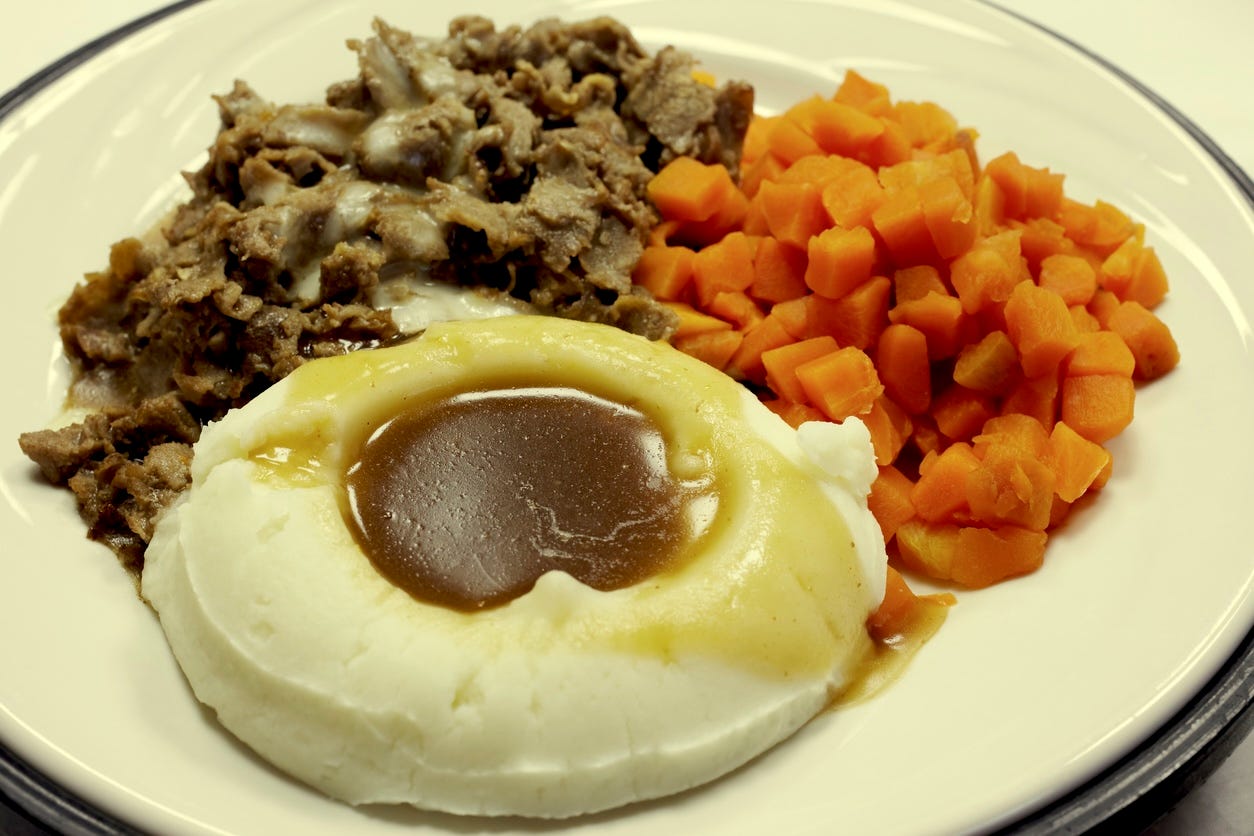
An orderly brings in a tray. He opens the lid so that Alex and the assembled can look inside. Down on the beige plastic plate, its edges scarred by hospital flatware and industrial soap, a brown-black blob exhales.